
Astronomy
Astronomical site operations, telescope automation and sky condition reporting.
Astronomical Observatory Support
The Solmirus ASIVA and ASIS infrared instruments are must-have tools for astronomical observatories — providing cloud cover and sky condition data to world-class observatories around the globe, supporting both scientific and automation tasks across a wide range of observing applications.
Our thermal IR imager has a distinct advantage over traditional sky monitors - it directly detects emission from clouds rather than relying on scattered light or obscured starlight. This provides consistent, reliable sky condition data under a wide variety of conditions, including thin cirrus that visible-light systems routinely miss.
The unique up-looking all-sky infrared lens captures unobscured hemispheric images across the full sky dome. Combined with a proprietary hatch system and calibration procedures, the result is unparalleled performance in determining sky and cloud radiance - enabling efficient telescope scheduling, improved data quality, and full telescope automation.
Why IR beats visible for an all-sky camera
A visible all-sky camera needs something to illuminate the clouds. An infrared all-sky camera measures what the sky itself emits - so it works identically at noon, at midnight, and at new moon.
- 24/7 operation. No twilight gap, no dependence on lunar phase. Assess conditions at 4 p.m. to plan the night.
- Sub-visual cirrus. Thin cirrus at optical depth 0.05 is invisible to a visible camera but costs several percent in transparency. In IR it's an emitting layer with an unmistakable signature. For absolute photometry, this alone is the argument.
- A measurement, not a mask. Calibrated radiance gives cloud temperature, and with a lapse rate, cloud base height and optical depth. A number for your FITS header - not a binary cloudy/clear pixel count.
- Precipitable water vapor for free. Clear-sky IR radiance is a direct function of column water, the dominant extinction term in the IR and submm. You'd otherwise buy a separate radiometer.
- Immune to what wrecks visible. Moonlight scattering, dome lights, street lighting, airglow. None of it registers at 10 µm.
Where visible still helps
A visible transparency map measures extinction directly, in the band you actually observe in, and independently checks your photometric zero point. IR infers transparency through a cloud-emission model - visible measures it.
They answer different questions. IR answers what is the sky doing, and what will it do in twenty minutes - every pixel, day and night, referenced to an onboard blackbody each calibration cycle. Those are the decisions you make before and during a night: which target, which filter, when to close. Visible answers what did that cost me, after the photons are already on the detector.
One schedules the night. The other reconciles it. Running both stops guessing at either end.
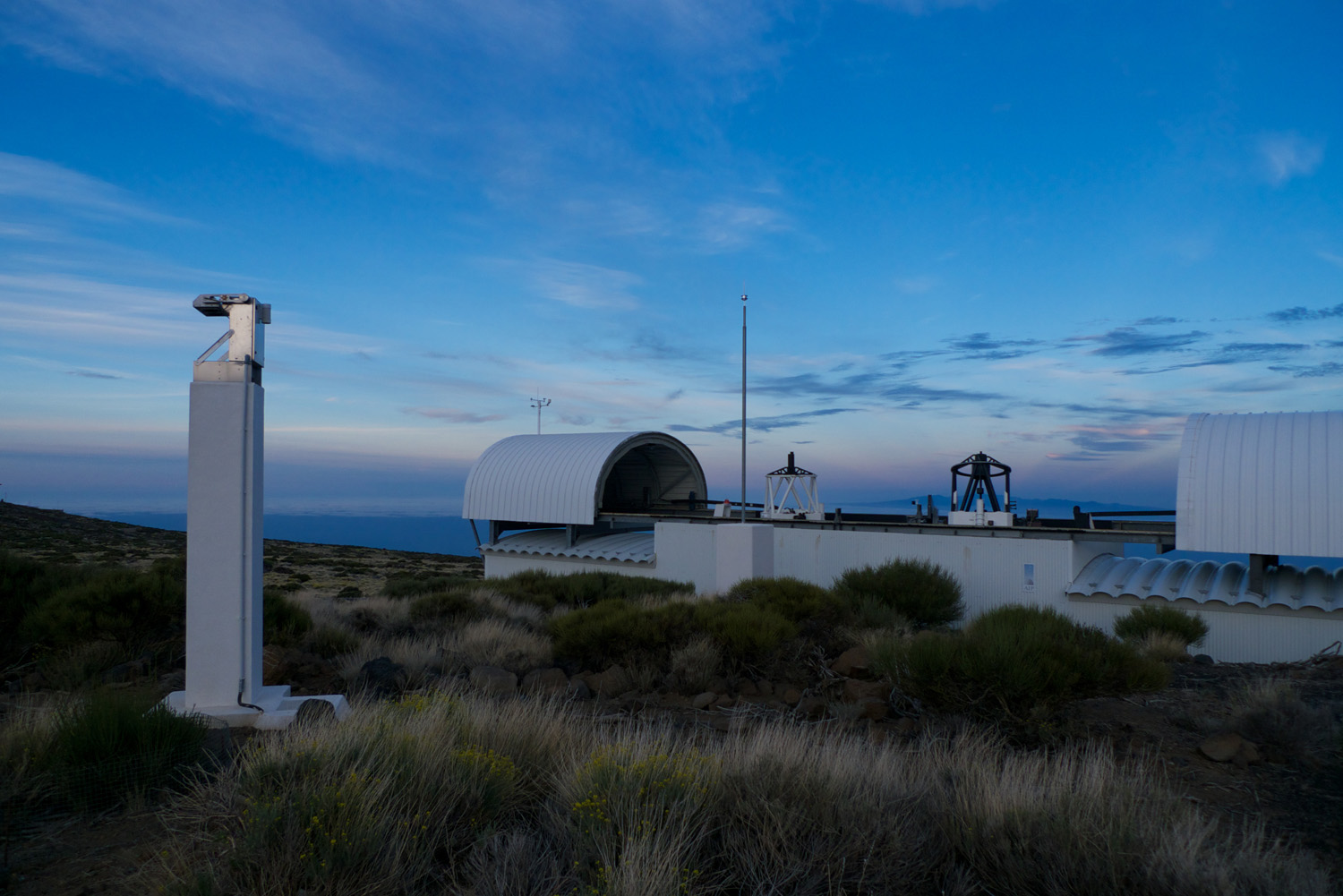
ASIVA all-sky IR imagery supporting observatory operations and telescope automation
Why IR Over Visible Sky Monitors?
Traditional visible-light sky cameras rely on scattered light or obscured starlight to infer cloud presence. Infrared imaging directly measures thermal emission from clouds — delivering reliable sky condition data day or night, through thin cirrus, and under conditions where visible systems fail entirely.
Notable Capabilities for Astronomers
IR Image Coadding
Coadding capabilities of IR images for improved signal-to-noise ratio — enhancing detection of faint cloud structure and improving measurement precision.
Spectral Radiance Measurement
Superior spectral radiance measurements delivering calibrated, quantitative sky data beyond simple cloud detection — supporting detailed site characterization.
Thin Cirrus Detection
Sensitivity to thin cirrus clouds that visible-light sky monitors routinely miss — critical for protecting sensitive instruments and ensuring data integrity.
Multi-Filter Analysis
Customizable multi-filter analysis in both infrared and visible spectrum — adaptable to the specific observing and atmospheric characterization needs of each facility.
Real-Time Cadence Reporting
Small cadence time supports real-time sky condition reporting — enabling responsive telescope scheduling and automated go/no-go decision making.
16-Bit HDR Imagery
High dynamic range 16-bit images support detailed atmospheric research of the site — providing the full radiometric depth needed for scientific analysis.
Equip your observatory with all-sky IR monitoring
Contact us to discuss your observatory's requirements or download our instrument specifications.
Inquiry Form
Tell us about your FSO or atmospheric sensing project. Please complete the form below and a member of our team will respond within 1–2 business days.
Inquiry Submitted
Thank you — your project inquiry has been received. A member of the Solmirus team will be in touch shortly.